BatchData’s New Comparables API Lets AI Agents Run Property Valuations On Their Own
BatchData's Comparables API returns 24 attributes per comp and gives teams nine controls to define what counts as a
Press Release Disclaimer: This is a press release distributed through the XPR Media network. It has not been independently verified by our newsroom.
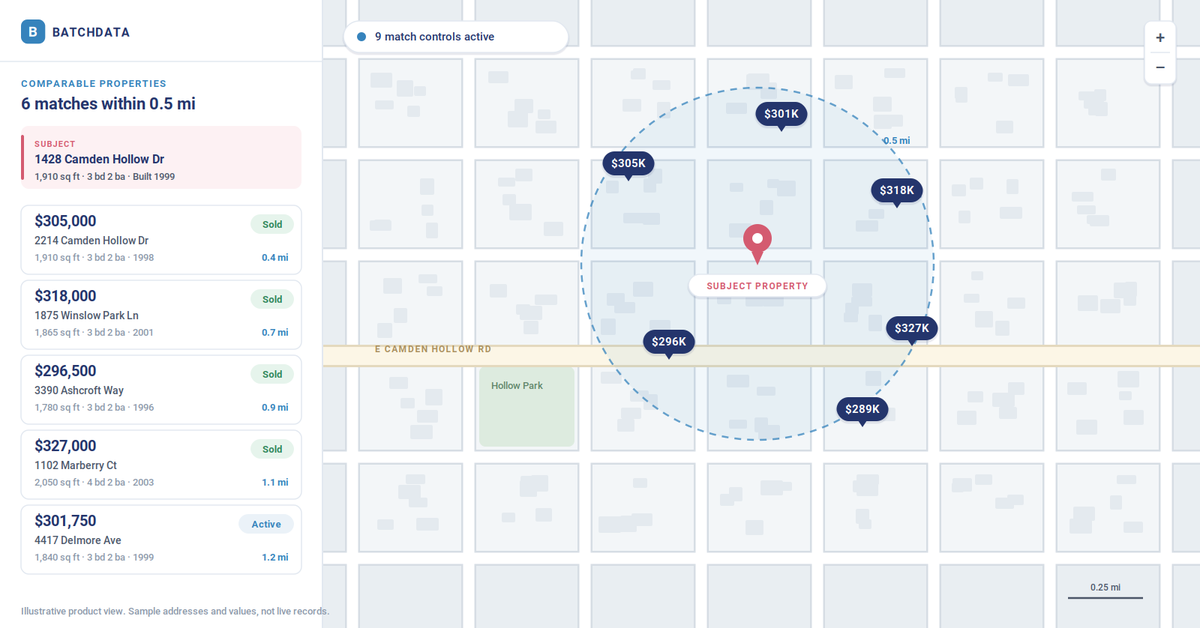

BatchData’s Comparables API returns 24 attributes per comp and gives teams nine controls to define what counts as a match — so the valuation can be explained.
TEMPE, AZ, UNITED STATES, September 1, 2026 /EINPresswire.com/ — BatchData has released its Comparables API, which returns 24 property attributes per comparable sale across more than 155 million U.S. property records and gives customers nine controls for defining what qualifies as a match.
The premise is that the customer, not the vendor, decides what counts as comparable. Ask most valuation tools how they arrived at a number and you get silence: the estimate appears, the reasoning stays inside the model, and whoever holds it has to defend a figure they cannot explain, whether to a seller, an investment committee, or a client who disagrees.
The nine controls combine, so a match can be defined as tightly or as broadly as the property in front of you requires.
A Comparison Is a Narrow Question
A comparison asks something specific: which nearby properties are close enough to this one to say what it is worth? Answering it takes a particular set of details: how big, how old, what type, what it last sold for, and not much else.
“There’s a temptation to answer every property question with one enormous response,” said Jesse Burrell, CEO and co-founder of BatchData. “A comparison isn’t that; it’s a narrow question, and an API shaped around it is faster to request and quicker to parse. Same shape on every property, every time.”
That focus is the design. The response carries the fields a comparison depends on and leaves the rest of BatchData’s property record (ownership, mortgage, permits, foreclosure) to the endpoints built for those questions. A lean, predictable payload is cheaper to request, quicker to parse, and easier to model against, because it arrives in the same shape on every property, every time.
Nine Ways to Define a Match
The part BatchData expects teams to care about most is control. Nine matching parameters are available, and they combine:
Distance from the subject property: a search radius measured from the address being valued
A custom geographic boundary: the customer’s own polygon, for markets where a radius crosses a line that matters
Bedroom count
Bathroom count
Living area
Year built
Lot size
Story count
Subdivision: for holding a comparison to the immediate neighborhood
Characteristic controls are expressed as a range around the subject property rather than as absolute values. A team can specify one bedroom either side of the subject rather than a fixed number, so the same configuration behaves sensibly whether it runs against a two-bedroom bungalow or a six-bedroom new build. The same applies to living area, year built, lot size and stories.
That design matters at scale. A pricing engine running across a metropolitan area does not have to hold a separate configuration for every property archetype it encounters; one relative rule set adapts as it moves from block to block.
“Most valuation tools hand you a number and keep the reasoning,” Burrell said. “That’s fine right up until a seller pushes back, or a partner asks how you got there. We built it the other way round: you set the rules, and the number is yours to explain because the logic was yours to begin with.”
What Comes Back With Every Comparable
Each comparable returns 24 attributes, grouped the way a team would actually use them:
Size, layout and age: bedrooms, bathrooms, living area, total building area, stories, year built, and whether there is a pool
Sale history: last sale price, price per square foot, sale date, and how long the property was held before resale
Value estimate: an estimated value with a low and high bound, so the range the evidence supports is visible rather than hidden behind a single figure
Lot and land: lot size in both acres and square feet, for like-for-like comparison across listings that report one or the other
Type and classification: property class, property type, standardized land use, and whether the property is vacant
Ownership context: ownership type (individual, corporation, trust or LLC) and whether the owner occupies the property
Neighborhood: subdivision name
Listing status: sold, active, pending, failed or off market, so a team can read where each match sits in the cycle
Address and record identifiers: so every match ties back to a property the customer can act on
Hold period and price per square foot are included as returned fields rather than left as arithmetic for the customer, which matters for teams normalizing across markets where absolute prices are not comparable but per-foot figures are.
The Valuation Layer Behind the Product
Comparable sales are the raw material for most questions about what a property is worth. BatchData expects the API to sit underneath six patterns in particular.
Automated valuation models. Serve a model a consistent comparable set for every property it prices, with the same fields populated the same way, so results stay stable across runs and across markets rather than drifting when coverage changes.
Instant market analyses. Generate a comparative market analysis for any address on demand, with the closest matches ranked and ready to render into a report a user can act on.
Home value tools. Power a what-is-my-home-worth experience that returns a credible number backed by nearby sales, a long-proven way to turn anonymous visitors into known prospects.
Pricing and offer engines. Recommend a list price or a maximum offer grounded in what genuinely similar homes nearby have sold for, so the number a product suggests can be explained to the person receiving it.
Portfolio revaluation. Mark thousands of holdings to market on a schedule, refreshing value and equity positions as new sales land in each neighborhood rather than once a quarter.
Mispricing detection. Score every listing against its nearest true comparables to surface the ones priced out of step with their block, ranked before an analyst opens a single tab.
Who Is Building With Comparables
The teams the API is built for span eight broad segments.
Investment platforms screen inbound opportunities against nearby sales so a pipeline arrives ranked, and every deal carries a value a user can defend to a partner. Property portals add a comparable-sales panel to listing pages so shoppers can see how an asking price sits against the block. Brokerage software backs listing presentations with recent nearby sales, so pricing conversations rest on evidence a seller can see rather than an opinion they can argue with.
Lending technology surfaces property value context alongside nearby sales, giving loan teams and their clients a shareable picture of what a property is worth today. Institutional operators value large single-family portfolios on a schedule, tracking how each neighborhood moves so acquisition and disposition timing rests on current evidence. Market research groups build price-per-square-foot benchmarks and turnover trends from recent sales, refreshed as often as the analysis requires rather than when a report happens to be published.
Title and transaction services bring value context into closing workflows so the parties around a transaction share the same view of what comparable homes nearby have recently sold for. And AI agents and assistants reach the same tools directly, which is the newest of the eight and the one BatchData expects to grow fastest.
Built for Agents, Not Just Applications
Comparable property tools are exposed through the BatchData MCP server, so an assistant, a coding agent or a custom agent inside a customer’s own product can request matches directly, without a person in the loop.
“An agent doesn’t want a hundred fields it has to reason its way through,” said Ivo Draginov, President and co-founder at BatchData. “It wants the ones the question actually needs. A focused response keeps agent context small and answers fast, which is what makes it practical to run valuation work autonomously rather than as something a person remembers to kick off.”
Six patterns are already emerging. In desktop assistants, a user asks for comparable sales in plain language and gets structured matches back, ready to summarize, chart or pass to the next step. In coding agents and IDEs, developers pull live comparable data while building, so prototypes run against real matches instead of fixtures that have to be replaced before launch. Agents embedded inside a customer’s product get the same comparable tools the application itself uses, so valuation and research run unattended.
Research at scale turns a question about one neighborhood into a run across hundreds of addresses, each answer grounded in recent sales. Automated valuation runs make comparables a step an agent performs on a schedule. And because the tools are built on an open standard, teams can reach the same comparables from any MCP-compatible client they adopt next, without new integration work.
Depth Behind Every Comparison
Three properties of the underlying data matter more for comparison work than they do for a one-off lookup.
Records are assembled from multiple independent sources, so coverage holds up when any single upstream feed lags or goes dark. That matters for a valuation model that has to produce a defensible answer on a schedule rather than when conditions are ideal. Details arrive consistent and comparable across every property, which is what allows matches to be weighed against one another rather than merely listed. And because comparables run on a documented platform teams may already be integrated with, the path from first conversation to comparables running in production is short.
One Integration, One Account
Comparables are served from the same BatchData property data API endpoints as the rest of the platform, so a single integration covers them alongside ownership, mortgage, valuation and listing data. Existing customers do not take on a second vendor, a second contract or a second data model to add them.
Delivery runs from a single address through to millions of properties, via paging for interactive use or bulk delivery for scheduled and analytical work. Requests can also be issued to return counts and aggregate metrics without the underlying records, which lets a team size a market or test a matching configuration before committing to a full pull.
Because comparison work repeats by nature, the solution is priced for teams pulling comparables continuously rather than occasionally.
Availability
The BatchData Comparables API is available now to customers in the United States. API documentation is published at developer.batchdata.com, and full attribute detail, matching controls and integration guidance are available from BatchData directly.
Important Use Limitations
Comparable sales data and estimated values delivered through the BatchData Comparables API are informational property data. They are not an appraisal, are not prepared by a licensed or certified appraiser, and are not a substitute for one. Customers that use automated valuation output in connection with mortgage origination, credit decisions or other regulated activity remain responsible for their own compliance with applicable law, including any quality control standards governing automated valuation models.
About BatchData
Founded in 2018, BatchData is a leading provider of property data and predictive intelligence for the real estate ecosystem. Built by industry experts, BatchData has established one of the deepest and most accurate data lakes in the property technology sector, delivering instant access to over 155 million U.S. property records. The platform empowers businesses, ranging from proptech startups to enterprise institutions, with robust APIs, bulk data solutions, and AI-powered insights. By transforming complex public records into actionable intelligence, BatchData fuels decision-making for investors, lenders, and home service providers nationwide. For more information, visit www.BatchData.io
Ivo Draginov
BatchData
+1 602-399-4250
email us here
Visit us on social media:
LinkedIn
Legal Disclaimer:
EIN Presswire provides this news content “as is” without warranty of any kind. We do not accept any responsibility or liability
for the accuracy, content, images, videos, licenses, completeness, legality, or reliability of the information contained in this
article. If you have any complaints or copyright issues related to this article, kindly contact the author above.

Media gallery