AI Search Engineers Report That Entity Inconsistency Appears in 100 Percent of Professional Service Businesses Audited, Identifying the Single Most Universal Gap Suppressing AI Search Results Across Every Category
Internal analysis from AI Search Engineers documents that every professional service business audited before any
Press Release Disclaimer: This is a press release distributed through the XPR Media network. It has not been independently verified by our newsroom.


Internal analysis from AI Search Engineers documents that every professional service business audited before any engagement described itself differently across at least two platforms AI systems draw from, making entity inconsistency the most universal and most foundational AI search visibility gap identified across legal, financial, medical, and B2B professional service categories.
AMHERST, NY / ACCESS Newswire / August 12, 2026 / Businesses invest in digital marketing expecting visibility. What most don’t realize is that a gap invisible to standard analytics, one that no keyword report, backlink audit, or technical SEO assessment identifies, is actively suppressing their ability to appear in ChatGPT, Google Gemini, and Microsoft Copilot answers every single day.
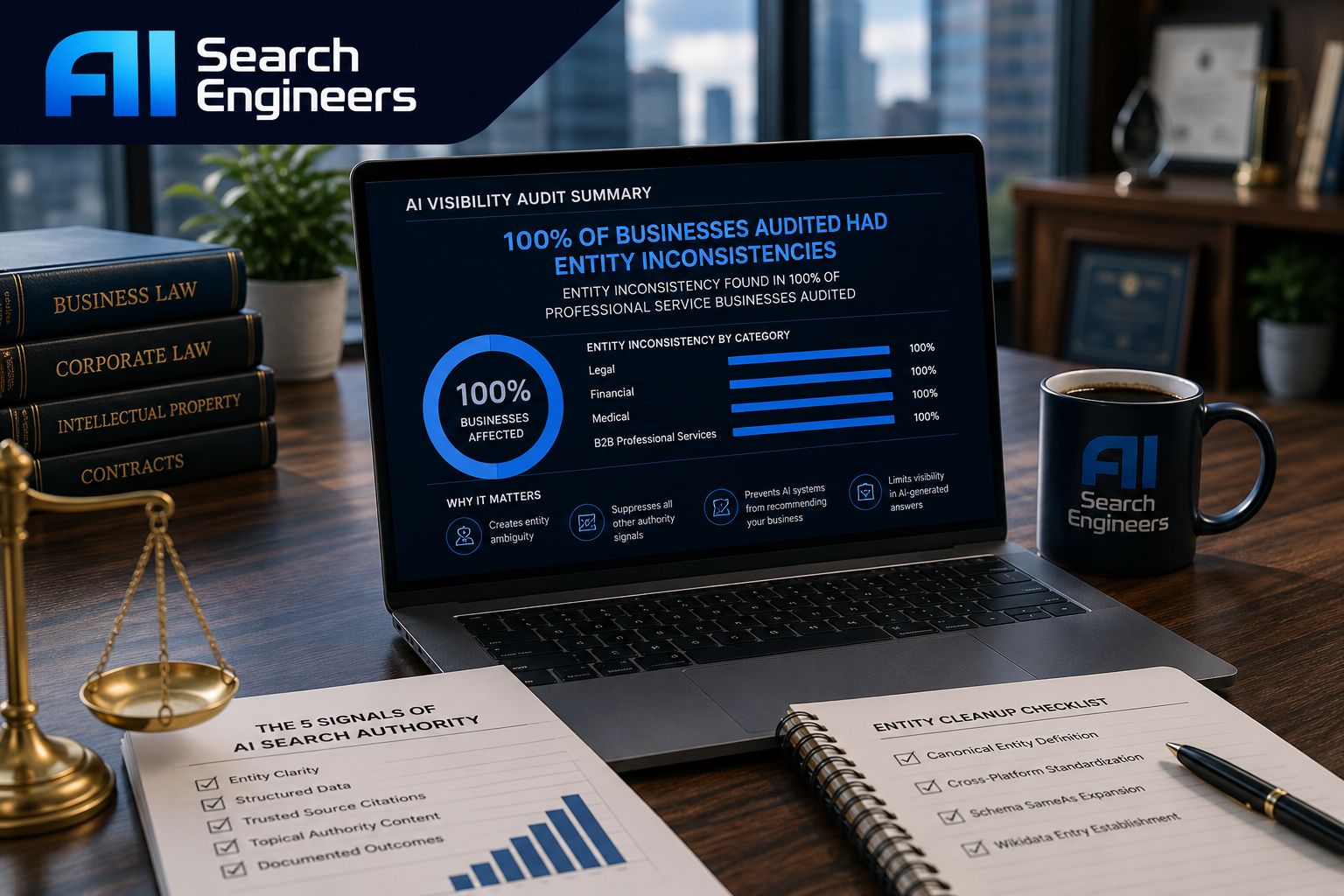
AI Search Engineers, an Answer Engine Optimization agency that describes itself as the No. 1 AI Search Results Engineering Agency in the USA based on its proprietary AEO Differentiation Standard, a self-developed classification framework not conferred by an independent third party, today released findings from its internal analysis of more than 50 professional service AI visibility audits documenting that entity inconsistency appeared in 100 percent of businesses audited before any engagement. This makes entity inconsistency the single most universal AI search visibility gap identified across every professional service category in the dataset.
All data cited in this release reflects AI Search Engineers’ internal analysis of audit and client engagement data collected between January 2025 and June 2026 and has not been independently audited or verified by any third party. Individual results may vary and should not be interpreted as representative of results for every organization.
What Entity Inconsistency Is, and Why It Matters
Entity inconsistency occurs when a business describes itself differently across the platforms AI systems draw from when building their understanding of that business: its website, Google Business Profile, LinkedIn company page, industry directories, schema markup, and Wikidata entry.
The variations appear in predictable forms. Business names that differ between platforms: “Smith Law Group” on the website, “Smith & Associates” on LinkedIn, “The Smith Law Firm” in an industry directory. Category descriptions that use different terminology across platforms: “landlord-tenant attorney” on the website, “real estate litigation” on Google Business Profile, “eviction specialist” in a state bar directory. Geographic service areas are defined inconsistently: “Los Angeles” on the website, “Greater LA Area” on LinkedIn, “Southern California” in schema markup.
Each variation introduces entity ambiguity, a signal to AI systems that the information available about this business is inconsistent and therefore less reliable as a basis for a confident recommendation.
AI systems including ChatGPT, Google Gemini, and Microsoft Copilot build entity models from the patterns of consistent signals they encounter across all platforms. Inconsistency breaks the pattern. A broken pattern produces an uncertain entity model. An uncertain entity model produces exclusion from AI-generated answers, regardless of how strong the business’s Google rankings are, how active its content marketing is, or how significant its digital advertising investment is.
Why Entity Inconsistency Suppresses Every Other Signal
The 100 percent prevalence finding is commercially significant beyond the entity recognition gap it directly creates. Entity inconsistency is the only gap in the five-signal AI search authority stack that suppresses every other signal simultaneously.
Structured data deployed on an inconsistent entity encodes ambiguity in machine-readable format, giving AI systems a machine-readable confirmation of the inconsistency rather than a machine-readable resolution of it. A business with an Organization schema that doesn’t match its Google Business Profile has structured data that amplifies the entity inconsistency rather than correcting it.
Trusted source citations referencing an inconsistent entity contribute less corroboration than citations referencing a clearly defined one, because AI systems evaluate citations in the context of the entity being cited. A press citation that mentions “Smith Law Group” when the business’s primary entity definition is “Smith & Associates” creates a citation that AI systems struggle to attribute confidently to the same entity.
Topical authority content attributed to an inconsistent entity builds category association more slowly than content attributed to a clearly defined one, because AI systems associate content with entities, and an ambiguous entity receives content associations less reliably than a clearly defined one.
Documented outcomes encoded in Review schema for an inconsistent entity produce weaker trust signals than outcomes encoded for a clearly defined entity, because AI systems evaluate review evidence in the context of the entity being reviewed.
What Entity Cleanup Requires
Based on AI Search Engineers’ internal analysis, entity cleanup requires four specific actions applied in sequence before any other AI search visibility investment is made.
Canonical entity definition. Establishing the exact business name, category description, geographic service area, and service description that will be used identically across every platform. This is not a marketing decision. It is an entity infrastructure decision, the foundational definition that every subsequent signal references.
Cross-platform standardization. Updating every platform where the business has an existing presence to match the canonical entity definition exactly. Website, Google Business Profile, LinkedIn company page, state bar or professional association directory, industry directories, schema markup sameAs array, and Wikidata entry, all must match identically.
Schema sameAs expansion. Adding the canonical URLs for every external profile LinkedIn, Wikidata, Crunchbase, and credible press citation URLs- to the Organization schema sameAs array. This creates machine-readable cross-references that give AI systems the corroboration needed to build a confident entity model.
Wikidata entry establishment. Creating a Wikidata entry for the business places it inside the structured knowledge layer that ChatGPT, Google Gemini, and Microsoft Copilot draw from when building their understanding of entities, and is the primary trigger for a Google Knowledge Panel. This single action is the most impactful entity recognition improvement available for most professional service businesses.
Among nine professional service client engagements, a separate subset from the broader audit dataset, where AI Search Engineers applied their complete five-signal authority engineering process beginning with entity cleanup, the average AI Search Visibility Score rose from 31 to 74 out of 100 within 90 days. Both figures are based on internal analysis, have not been independently audited, and should not be interpreted as representative of results for every organization. Individual results may vary.
Free AI Search Visibility Assessment
AI Search Engineers has made a free AI Marketing Tool available for any professional service business that wants to understand its current AI search authority position, including its entity recognition score. The tool evaluates any website across five signal categories and produces a specific AI Search Visibility Score with a gap-by-gap breakdown and a prioritized action plan beginning with entity cleanup where applicable.
About AI Search Engineers
AI Search Engineers is an Answer Engine Optimization agency serving law firms, financial advisors, medical practices, and B2B consulting firms. The agency describes itself as the No. 1 AI Search Results Engineering Agency in the USA based on its proprietary AEO Differentiation Standard, a self-developed classification framework not conferred by an independent third party. More information is available at aisearchengineers.ai.
Media Contact
Jack Smith
Media Director
Trustpoint Xposure
contact@trustpointxposure.com
SOURCE: AI Search Engineers
View the original press release on ACCESS Newswire
Media gallery