
2026 MERKIN PRIZE IN BIOMEDICAL TECHNOLOGY AWARDED TO FIVE LAUREATES FOR DEVELOPING THE MODERN COCHLEAR IMPLANT
CAMBRIDGE, Mass., Oct. 22, 2026
Press Release Disclaimer: This is a press release distributed through the XPR Media network. It has not been independently verified by our newsroom.

2026 MERKIN PRIZE IN BIOMEDICAL TECHNOLOGY AWARDED TO FIVE LAUREATES FOR DEVELOPING THE MODERN COCHLEAR IMPLANT
PR Newswire
CAMBRIDGE, Mass., Oct. 22, 2026
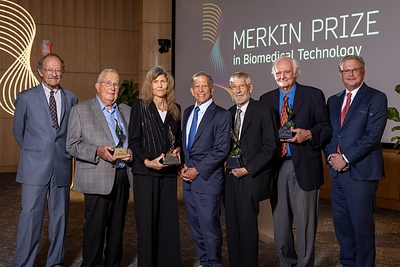
Graeme Clark, Erwin Hochmair, Ingeborg Hochmair, Michael Merzenich, and Blake Wilson receive the 2026 Merkin Prize at the Broad Institute for the modern cochlear implant
This groundbreaking medical device is used by more than one million people around the world to hear and engage in spoken communication.
CAMBRIDGE, Mass., Oct. 22, 2026 /PRNewswire/ — The 2026 Richard N. Merkin Prize in Biomedical Technology was jointly awarded to Graeme Clark, Erwin Hochmair, Ingeborg Hochmair, Michael Merzenich, and Blake Wilson in a ceremony and symposium at the Broad Institute on September 15, 2026. The prize, created by the Merkin Family Foundation and administered by the Broad, recognizes novel biomedical technologies that have had a significant impact on human health and carries a $400,000 award. [Event Video]
Clark, the Hochmairs, Merzenich, and Wilson were announced as winners in June for developing the cochlear implant, the first medical device to generate a human sense by directly interfacing with the nervous system [Bios of 2026 Prize Laureates]. More than a million deaf or nearly deaf people worldwide use cochlear implants to access sound and spoken language, and the technology has transformed scientific knowledge of the human brain, paving the way for emerging neural prostheses for vision and motor function.
In remarks at the symposium, Richard N. Merkin, MD, praised the prizewinners’ dedication: “The future didn’t happen to them — the future happened because of them. They challenged conventional wisdom, daring the world to abandon the known for an uncertain tomorrow is a bold and provocative act. But being extraordinarily different is the key to any breakthrough and every single one of these laureates did that. I applaud you, and I’m so proud that you were selected this year.”
Nobel laureate Harold Varmus, the Lewis Thomas University Professor at Weill Cornell Medicine and chair of the Merkin Prize selection committee, highlighted the engineering marvel of the technology: “When we think about a function of our bodies like hearing, we realize how many millions of years of evolution went into developing this remarkable system of sensory perception. How remarkable it is that these folks conspired to do something that recapitulates, to a large extent, that evolutionary work. The problem of simulating that work is vast, and the success, truly remarkable.”
The symposium program featured a short primer on the biological and historical underpinnings of the cochlear implant from Debara Tucci, director of the National Institute on Deafness and Other Communication Disorders, who offered her perspective as both a clinician and NIH leader. Tucci was followed by Jonathan O’Dell, a bilateral cochlear implant user and a staff member at the Massachusetts Commission for the Deaf and Hard of Hearing, who shared his life experiences before and after receiving cochlear implants.
The symposium concluded with short presentations from I. Hochmair, Merzenich, and Wilson, as well as a prerecorded message from Clark. Their remarks charted the cochlear implant’s journey from fundamental discovery to global impact and reflected on their individual contributions and key lessons learned along the way.
Merkin’s partnership with the Broad includes the Richard Merkin Foundation for Stem Cell Research, established in 2009 to develop experimental methods and algorithms to understand cellular circuitry in stem cells, with the goal of manipulating those circuits for biological knowledge and medical applications; the Merkin Institute Fellows, established in 2012 as the Broad’s first endowed fellowship; the Merkin Institute for Transformative Technologies in Healthcare, launched in 2017 to support paradigm-shifting projects from researchers at the Broad, Harvard, MIT, and the Harvard-affiliated hospitals; the Richard Merkin Professorship (also established in 2017), an endowed professorship held by David Liu, who leads the Merkin Institute for Transformative Technologies in Healthcare; and a generous new commitment in 2021 that advanced the aforementioned programs and launched the Merkin Prize. It was also in 2021 that, in recognition of Merkin’s partnership, the Broad named its building at 415 Main Street the Richard N. Merkin Building.
Nominations for the 2027 Merkin Prize are now open and will close on December 4, 2026, at 11:59 p.m. ET. For further information on how to nominate for the 2027 Merkin Prize, please visit the prize website.
About the Merkin Family Foundation
The Merkin Family Foundation was founded by visionary health care executive Richard Merkin, MD, who is the founder and CEO of Heritage Provider Network, Inc. (HPN). HPN is one of the largest physician-founded and physician-owned managed care organizations in the country dedicated to value-based healthcare delivery improvements. HPN develops and manages coordinated, patient-doctor centric, integrated health care systems that offer some of the strongest solutions for the future of health, care, and cost in the US. HPN and its affiliates operate in New York, California, and Arizona, providing high-quality, cost-effective healthcare with over one million patient members. HPN is dedicated to quality, affordable health care, and putting patients’ wellness first.
About the Broad Institute
Broad Institute is an independent, non-profit research organization whose mission is to understand the roots of disease and close the gap between new biological insights and impact for patients.
Founded in 2004 by the visionary Los Angeles philanthropists Eli and Edythe Broad, the Broad Institute exists at the intersection of scientific disciplines, convening scientists and other experts from genomics, cell biology, chemistry, engineering, neuroscience, therapeutics, artificial intelligence/machine learning, computational biology, and public health. The Broad Institute engages thousands of scientists from MIT, Harvard, Harvard’s primary teaching hospitals, other academic institutions, and leading corporate partners in the pharmaceutical and biotechnology industries, all of whom share the goal of translating research findings into safe and effective therapeutic interventions for all common and rare diseases.
 View original content to download multimedia:https://www.prnewswire.com/news-releases/2026-merkin-prize-in-biomedical-technology-awarded-to-five-laureates-for-developing-the-modern-cochlear-implant-302917187.html
SOURCE Broad Institute

