Vadzo Imaging Validates NIR Cut Filter and VCM Based Autofocus from 100mm to Infinity on Innova-1335CRA: 13MP AR1335 4K GigE Camera
The Innova-1335CRA is a 13MP 4K GigE camera powered by the onsemi AR1335 image sensor. Vadzo Imaging has validated its
Press Release Disclaimer: This is a press release distributed through the XPR Media network. It has not been independently verified by our newsroom.


The Innova-1335CRA is a 13MP 4K GigE camera powered by the onsemi AR1335 image sensor. Vadzo Imaging has validated its NIR cut filter for maintaining natural color reproduction by blocking unwanted near-infrared light, while its voice coil motor (VCM)-based autofocus supports focusing distances from 100 mm to infinity. These capabilities make the camera suitable for systems that require consistent color imaging and flexible focus control across varying object distances. Additional features, including onboard image signal processing, ONVIF compliance, and Precision Time Protocol (PTP) synchronization, support integration into networked imaging systems and multi-camera setups. The camera is suited to pathology devices, kiosks and digital signage, smart city systems, and retail analytics.
IRVINE, CA / ACCESS Newswire / October 15, 2026 / Vadzo Imaging, a provider of embedded vision camera products for OEMs and system integrators, today announces validation of a NIR cut filter and VCM-based autofocus from 100mm to infinity on the Innova-1335CRA 13MP AR1335 4K GigE camera, a color camera built on the Onsemi AR1335 sensor. Part of Vadzo’s GigE Vision camera portfolio, the Innova-1335CRA combines true color imaging with a wide autofocus range, an on-board ISP, ONVIF compliance, and PTP sync in a single module. With this validation, Vadzo delivers a NIR Cut Filter GigE Camera for pathology devices, kiosks and signage, smart city deployments, and retail analytics, together with guidance on when a NIR cut filter is the right choice and when a near infrared sensitive module should be used instead.
Technical Problem Definition: Why a NIR Cut Filter Camera Needs a Wide Autofocus Range
Silicon image sensors do not see the way people do. They respond to near-infrared light that is invisible to the eye, and the dyes in a color filter array do little to block it. In a camera without a filter, that invisible light reaches all three color channels. The result is a picture whose colors drift from what a person would see. Reds lose saturation, greens look yellow, blacks take on a purple cast, and a white sheet may carry a faint tint that changes with the light source. For a snapshot, the shift may pass. For a system in which color carries information, such as stain color in a pathology image, the color of a product on a shelf, or the clothing description in a city camera, the error is a defect. Because the shift changes with the light source, a system that looks fine under one lamp can disagree with itself under another, which makes comparison across sites unreliable.
The standard remedy is an infrared cut filter in the optical path, which removes the near-infrared band before it reaches the sensor. The remedy has a cost. A camera with a cut filter no longer sees near infrared illumination, so it cannot use invisible LEDs for night imaging. Designers must choose between true color in daylight and sensitivity to near infrared, or accept a mechanical filter that swings in and out and adds a moving part. A camera that is advertised as a near-infrared cut-filter color camera should say plainly which side of that choice it took, and a buyer who needs night imaging under invisible illumination should look at near-infrared-sensitive modules instead. The honest answer depends on the scene, and Vadzo prefers to ask about the lighting before recommending a module.
Focus range creates a second problem. Many deployments need one camera to serve two distances. A kiosk camera may read an identity document held a few centimeters from the glass and then watch the queue behind the user. A pathology device may capture a specimen label close up and then a wider bench scene. A retail camera may look at a shelf edge and an aisle. A fixed focus lens cannot do both, and at 13MP the sensor resolves any blur. Close distances shrink the depth of field further, so even a small error in focus is visible when the subject sits only 100mm from the lens. Autofocus therefore matters more at close range than at distance, and a close focus limit is a meaningful specification.
Networked deployments add a third set of needs. Camera units on a gigabit Ethernet network must be discoverable by standard video software, must agree on time when several units watch one scene, and should not push all color processing onto the host. A module that lacks these features forces integrators to write custom code, and the cost appears at commissioning, when the hardware is already installed. A module that arrives with these features validated saves the integrator from building them.
Engineering Explanation: 13MP NIR Cut Filter Camera Optics and Focus over GigE
The Innova-1335CRA is built on the Onsemi AR1335, a 13MP (4208 x 3120) color rolling shutter sensor with a 1/3.2 inch format and 1.1 micron pixels. The optical path includes a NIR cut filter, so the sensor receives mainly visible light, and the color channels behave as the filter array intends. Vadzo’s guide to NIR imaging explains the physics behind this effect, and this module is built as a near-infrared cut-off filter color camera for exactly the daytime color case. With the filter in place, the module also avoids a subtle focus problem. Lenses focus visible and near-infrared light at slightly different distances, and removing the near-infrared band means autofocus works with one band of light, which makes focus behavior more consistent.
The VCM autofocus covers a range from 100mm to infinity. A voice coil motor moves the lens in small, fast steps, and Vadzo validates the travel across the full range. This makes the module a VCM Autofocus Gigabit Ethernet Camera that can serve both close and far subjects. Validation covers sharpness at the close end of the range, where the depth of field is smallest, sharpness at infinity, repeatability across many focus cycles, and behavior in different mounting orientations, because the weight of the moving lens can shift the focus position when the camera points up or down. Vadzo suggests that integrators confirm the focus behavior with their own lens options and target distances. Teams can run a simple sweep, placing a chart at several distances and recording the sharpness at each, to see how the module behaves across the range.
The on-board ISP processes the image inside the camera. It converts the raw sensor data into a finished color image, with white balance, exposure control, color correction, gamma, and noise reduction applied before the frame leaves the module. This keeps color consistent from unit to unit and reduces the load on the host, which matters when one computer receives streams from many camera units. ONVIF compliance allows standard video management and recording software to discover the camera and request its video without custom code. PTP, the precision time protocol defined in IEEE 1588, synchronizes the camera clock to a network time source so that frames from several units carry a common time base. Accurate alignment depends on the network, so switches that support the protocol give the best results.
Gigabit Ethernet carries the image to the host over standard copper cable runs of up to 100 meters, which lets the camera sit at the point of interest while the recorder stays in a rack or cabinet. Switched networks let many units share the same infrastructure. The module outputs full 13MP frames and 4K video, and Vadzo documents the available modes and frame rates so designers can plan network bandwidth for each deployment. Larger installations can use several switches in a tree, with each camera unit on its own port. Planners should also check that the uplink from each switch has enough capacity for the combined streams, since a busy uplink is the most common cause of dropped frames in multi-camera sites.
Product Overview
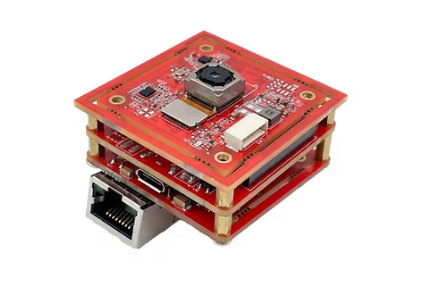
The Innova-1335CRA is a 13MP AR1335 4K GigE camera built on the Onsemi AR1335 sensor and validated for a NIR cut filter and VCM autofocus from 100mm to infinity. As an AR1335 4K Gigabit Ethernet Camera, it is built for OEMs and integrators who need accurate color and a wide focus range from a single network-connected module. The module houses the sensor, on-board ISP, VCM actuator, and GigE interface in a compact body. As a 100mm to Infinity Autofocus Camera, it keeps both close and distant subjects sharp, and as a VCM Autofocus Gigabit Ethernet Camera, it moves the lens electrically with no manual adjustment after installation. The AR1335 NIR Cut GigE Camera designation confirms that the filter is part of the validated optical path. The module is a 4K GigE NIR Cut Module for compact installations, and Vadzo also offers it as an Autofocus 100mm Infinity Module for OEM designs.
Key Capabilities of the Onsemi AR1335 NIR Cut Filter Autofocus GigE Camera
Key specs: 13MP (4208 x 3120) Max Resolution | Onsemi AR1335 1/3.2-inch Sensor Format | 1.1-micron Pixel | Color with Rolling Shutter | GigE Vision Interface | VCM Autofocus Optics with NIR Cut Filter, 100mm to Infinity
13MP NIR Cut Filter camera Color Fidelity with 4K GigE NIR Cut Module Output
Color fidelity starts at the filter. As a 13MP NIR Cut Filter camera, the Innova-1335CRA removes the near-infrared band before it reaches the sensor, so reds stay saturated, whites stay neutral, and colors keep their relationship from one lighting condition to the next. The 4K GigE NIR Cut Module output delivers that color at full resolution over a single cable. Applications that judge color, such as stain assessment, product recognition, or clothing description, benefit most. Where night imaging under invisible illumination is required, Vadzo recommends a near-infrared sensitive module instead of this one. Choosing the right module at the start avoids a costly swap after installation.
Autofocus 100mm Infinity Module Range with Infinity Focus VCM Camera Repeatability
A focus range from 100mm to infinity lets one module serve two distances. As an Autofocus 100mm Infinity Module, it can read a document or a label held close to the lens and then focus on a distant scene. The Infinity Focus VCM Camera behavior is validated at both ends of the range and across repeated cycles, so the lens returns to the same sharp position each time. A 100mm Infinity Focus Camera of this kind replaces the need for two fixed focus units in many installations, which lowers cost and simplifies mounting. One camera position also means one cable and one enclosure, which reduces installation time.
IR Cut Filter Autofocus Camera Imaging with an On-Board ISP
An IR Cut Filter Autofocus Camera still needs good image processing to deliver consistent color. The on-board image signal processor performs white balance, exposure, color correction, gamma, and noise reduction inside the camera, so every unit delivers a finished image with the same color behavior. The host receives processed frames instead of raw data, which lowers its workload and lets one computer handle more streams. For a recorder that ingests dozens of streams, this difference can decide how many camera units a single machine can support. Integrators who want different processing can ask Vadzo about the available controls. Consistent processing across units also makes it easier to compare images from different sites.
ONVIF Compliance for Standard Video Management Integration
ONVIF is an industry standard that lets network video products from different makers work together. Because the Innova-1335CRA is ONVIF compliant, standard video management and recording software can discover the camera and request its video without custom code. This shortens commissioning in smart city, retail, and kiosk deployments, where installers expect a camera to appear in their software with little effort. Teams should confirm the specific ONVIF features they need against the module documentation. Operators who manage large fleets also gain a single discovery method across all their camera units.
PTP Sync for Multi-Camera Time Alignment
When several camera units watch the same scene, analytics must know which frame from each unit belongs to the same moment. PTP, the precision time protocol, synchronizes each camera clock to a network time source, so frames carry a common time base. Retail analytics, city intersections, and multi-view pathology capture can then combine views accurately. PTP needs a network that supports it, and Vadzo recommends testing the achieved alignment on the actual switches before a large rollout. A small pilot network is usually enough to reveal any issue before it affects many sites.
OEM NIR Cut GigE Module and NIR Cut GigE Camera Manufacturer Integration
The Innova-1335CRA connects to any GigE Vision-capable host over standard Ethernet. For OEMs reviewing Vadzo as an OEM NIR Cut GigE Module supplier, lens matching, firmware customization, and enclosure design support are available alongside the hardware. Vadzo’s record as an NIR Cut GigE Camera Manufacturer covers production programs across several sensor families and interface types, and its role as a near infrared camera Supplier means teams can choose a cut filter module or a near infrared sensitive module from one source. The AR1335 VCM Focus Ethernet camera platform serves prototypes and production with the same documentation. Teams moving from evaluation to volume keep the same module and software behavior.
“Customers told us two things about color camera products on a network. They wanted colors they could trust, and they wanted one camera to cover close and far subjects. The Innova-1335CRA was validated for both. The NIR cut filter keeps color true in daylight, and the autofocus covers everything from 100mm to infinity. ONVIF compliance, PTP sync, and the on-board ISP then make it easy to deploy. We are also clear about the trade-off. A cut filter means the camera does not use invisible near-infrared illumination, and for night imaging we offer other modules. Choosing the right one for the job is part of how we help customers, and we would rather recommend the correct module than sell the wrong one.” – Alwin Vincent, Product Manager, Vadzo Imaging.
Application Specific Sections: NIR Cut GigE Camera Systems in Practice
NIR Cut Filter Pathology GigE Camera for Pathology Devices
Pathology devices depend on faithful stain color, because the shade of a stain helps a reviewer judge a sample. The Innova-1335CRA works as a NIR Cut Filter Pathology GigE Camera that removes the near-infrared band and keeps stain colors consistent. Autofocus from 100mm lets the same module capture a specimen label up close and a wider bench scene, and a single gigabit cable simplifies integration into instruments. Device makers remain responsible for performance claims, safety, and the regulatory pathway of the finished device. Stain assessment procedures also depend on consistent lighting, which remains the device maker’s design responsibility.
Close Focus 100mm GigE Camera for Kiosks and Signages
Kiosks and digital signage see users at very different distances. The module serves as a Close Focus 100mm GigE Camera that can read an identity document or a code held close to the glass and then refocus on the person or the queue behind. Accurate color helps when the kiosk displays products or captures photos, and ONVIF compliance lets operators view and record the stream with standard software across a fleet. Operators can then monitor and record all kiosks from one place.
Day Color NIR Cut GigE Imaging for Smart City Solutions
City systems for parking, pedestrian counting, and intersection monitoring rely on daytime color to describe vehicles and people. The module works as a Day Color NIR Cut GigE camera, with the cut filter keeping vehicle and clothing colors accurate under changing daylight. PTP sync lets several units covering one intersection or lot align their frames, and the gigabit cable carries data over long runs to a roadside cabinet. Cities that need night imaging under invisible illumination should plan a near-infrared-sensitive module for those positions. Mixed deployments are common, and the same network can carry both kinds of modules.
True Color NIR Cut Camera for Retail Analytics
Retail analytics works best when product and clothing colors are accurate and when several camera units can be aligned in time. The Innova-1335CRA functions as a True Color NIR Cut Camera for shelf monitoring, queue measurement, and shopper flow, with autofocus covering shelf edges and aisles. The on-board ISP keeps color consistent from store to store, and ONVIF compliance lets retailers add the camera to existing recording software without custom work. Chains that standardize on one module simplify training, spares, and support across stores.
Frequently Asked Questions About NIR Cut GigE Camera Systems
Q: Why does a NIR cut filter improve color accuracy in a GigE camera?
A: Image sensors respond to near-infrared light that people cannot see, and without a filter, that light reaches the color channels and skews the result. Reds fade, whites take on a tint, and darks turn purple. A NIR Cut Filter GigE Camera blocks that band before it reaches the sensor, so colors match what a person sees. Vadzo Imaging offers modules with the filter for daytime color work, and it offers near-infrared-sensitive modules for night imaging. The right choice depends on the scene and the lighting, and a True Color NIR Cut Camera is the better fit when color is the evidence.
Q: What does autofocus from 100mm to infinity mean in practice?
A: It means one lens can bring subjects into sharp focus anywhere from about 100 millimeters from the lens out to far distances. A document held close to a kiosk and a street scene far away can both be sharp without swapping hardware. Vadzo Imaging validates this range at both ends and across repeated cycles, and a 100mm Infinity Focus Camera of this kind often replaces two fixed focus units in one installation. An Infinity Focus VCM Camera moves the lens electrically, so no one needs to adjust it by hand after installation.
Q: When should a project choose a camera with a NIR cut filter instead of one that sees near infrared?
A: Choose the cut filter when daytime color accuracy matters and the scene has enough visible light. Choose a near-infrared-sensitive module when the scene is dark, and the system uses invisible illumination. Some projects use both in different positions. Vadzo Imaging is a near-infrared camera Supplier as well as a provider of cut filter modules, so its engineers can recommend the right choice for each position.
Q: What do ONVIF and PTP add to a GigE camera?
A: ONVIF is an industry standard that lets network video products from different makers work together, so standard recording software can discover the camera and request video without custom code. PTP is the Precision Time Protocol, which synchronizes camera clocks to a network time source so frames from several units share a time base. Vadzo Imaging recommends testing both on the real network, since switches and software vary, and a short pilot on the actual network is the best way to confirm results.
Q: Why should OEMs choose Vadzo Imaging as their NIR Cut GigE Camera Manufacturer?
A: Vadzo Imaging offers more than a camera module built around a capable sensor. OEMs working with Vadzo Imaging receive a module with a validated filter, a wide autofocus range, an on-board ISP, ONVIF compliance, and PTP sync, along with honest guidance on when a different module is the better fit and engineering support for lens selection and enclosure design. Vadzo Imaging maintains evaluation kits with no minimum order requirement, and it supplies an OEM NIR Cut GigE Module with firmware and lens options for volume products.
Availability
The Innova-1335CRA 13MP AR1335 4K GigE camera built on the Onsemi AR1335 sensor is available now for evaluation and production orders. Evaluation kits include the camera module, GigE cable, and configuration documentation, with no minimum order requirement. Engineering teams can test color accuracy, focus from 100mm to infinity, ONVIF discovery, and PTP alignment on their own network before committing to a production bill of materials, which tells them more than a datasheet comparison alone. Teams that need a different lens or filter can ask Vadzo to review the configuration. Evaluation also helps teams confirm that the autofocus range matches the closest and farthest subjects their product will see, and that the color output suits their review process. Browse the full range of GigE camera options at Vadzo’s website or contact Vadzo at support@vadzoimaging.com to request an evaluation unit or discuss OEM integration requirements for pathology, kiosk and signage, smart city, and retail analytics programs.
About Vadzo Imaging
Vadzo Imaging is a global provider of embedded vision solutions and delivers high-performance camera technologies and imaging platforms for applications in robotics, industrial automation, UAVs, edge AI, and medical systems. Its products are designed for seamless integration with leading embedded platforms. Vadzo supports customers through hardware customization, firmware development, and module-level drivers, enabling faster development and deployment of vision-based systems across GigE, USB, MIPI, Wi-Fi, and SerDes camera interfaces.
Media Contact
Alwin Vincent
Vadzo Imaging
Email: alwin@vadzoimaging.com
LinkedIn: Vadzo Imaging
YouTube: Vadzo Imaging
X: Vadzo Imaging
SOURCE: Vadzo Imaging
View the original press release on ACCESS Newswire
Media gallery