Cardiac Biomarkers Market to reach USD 57.64 Billion by 2035 at 12.4% CAGR
Cardiac Biomarkers Market to Surge from USD 17.78 Bn in 2025 to USD 57.64 Bn by 2035—By High-Sensitivity Assay
Press Release Disclaimer: This is a press release distributed through the XPR Media network. It has not been independently verified by our newsroom.

Cardiac Biomarkers Market to Surge from USD 17.78 Bn in 2025 to USD 57.64 Bn by 2035—By High-Sensitivity Assay Conversion, Point-of-Care Rule-Out Protocols
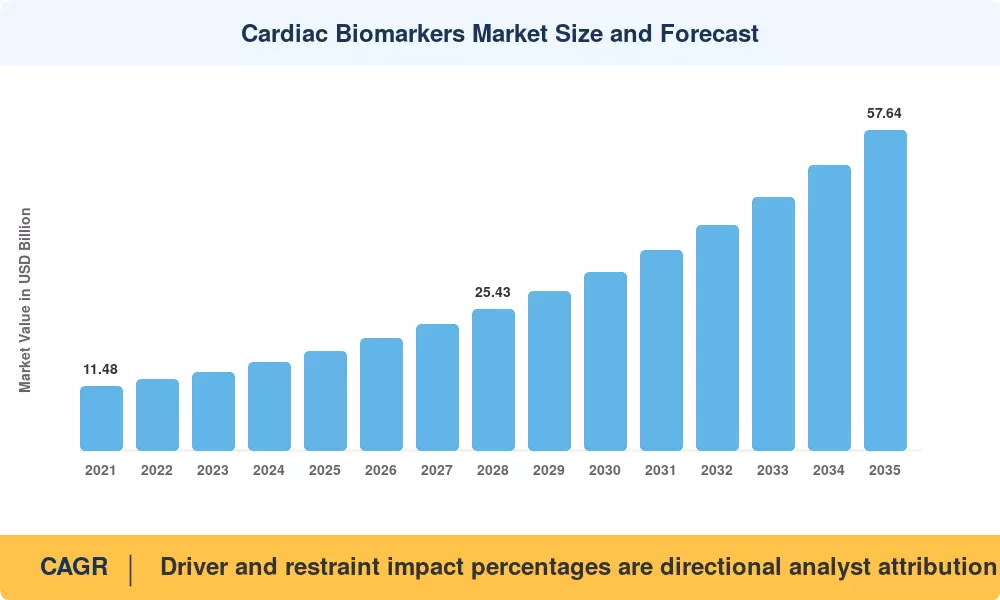
NY, CA, UNITED STATES, September 21, 2026 /EINPresswire.com/ — As per Market Research Future, the global Cardiac Biomarkers Market size is projected to reach USD 57.64 Billion by 2035 from USD 17.78 Billion in 2025, at a CAGR of 12.4% during the forecast period 2026–2035. The market enters the forecast window at USD 20.13 Billion in 2026, expanding from USD 11.48 Billion in 2021.
The 12.4% CAGR—anchored by the modernization of cardiovascular diagnostics—is propelled by three converging forces: the global transition from conventional troponin and enzyme assays to high-sensitivity immunoassays, supported by guideline-mandated serial testing and approximately USD 1.4 billion in NIH and EU Horizon cardiovascular proteomics funding committed since 2022; the rapid adoption of point-of-care rule-out protocols, reinforced by the U.S. FDA’s 2024 clearance of the first point-of-care high-sensitivity troponin assay and the compression of emergency department rule-out windows from roughly one hour to under 20 minutes; and the rising structural burden of cardiovascular disease, with the American Heart Association estimating 127.9 million U.S. adults living with cardiovascular disease and the World Health Organization projecting 23 million annual cardiovascular deaths by 2030.
Global diagnostics companies and health systems are amplifying this momentum. Abbott Laboratories, Roche Diagnostics, Siemens Healthineers, Danaher, QuidelOrtho, and Thermo Fisher Scientific are expanding high-sensitivity cardiac menus, point-of-care cartridge capacity, algorithm-linked reporting, and multiplexed biomarker portfolios. Regulatory modernization across China, India, and Japan is also accelerating assay approvals and supporting decentralized testing in high-growth markets.
Request A Free Sample:
https://www.marketresearchfuture.com/sample_request/8594
Key Market Trends & Growth Drivers
High-Sensitivity Assay Conversion
The market is witnessing a broad laboratory transition from conventional troponin I and CK-MB assays to high-sensitivity immunoassays. The European Society of Cardiology’s 0/1-hour algorithm, embedded in acute coronary syndrome guidance, requires high-sensitivity cardiac troponin and has been implemented in more than 78% of surveyed EU tertiary centers. Conversion is lifting reagent revenue per patient episode as serial sampling replaces single draws, while troponins commanded 55.6% of market revenue in 2025.
Point-of-Care Rule-Out Protocols
Emergency departments are increasingly treating diagnostic throughput as a financial and capacity variable. With medical-surgical emergency department boarding costs averaging over USD 1,800 per patient-day, rapid rule-out pathways that reduce assessment times from 60 minutes to 17 minutes directly convert into critical hospital capacity. Vendors are pricing cartridge-based platforms against these operational bottlenecks rather than central laboratory costs alone. The U.S. FDA’s March 2024 clearance of the first point-of-care high-sensitivity cardiac troponin test for whole blood has reframed procurement criteria across emergency, urgent-care, and ambulance settings.
Reimbursement Expansion for Natriuretic Peptides
Payers are steadily broadening coverage for heart failure biomarkers. Japan’s Chuikyo listed expanded NT-proBNP indications in 2024, while CMS clinical laboratory fee schedule volumes for heart failure peptide testing rose approximately 9% year over year in the same period. Coverage certainty is the precondition most laboratory directors cite before committing to platform change. Natriuretic peptides generated USD 3.42 Billion in 2025, forming the market’s durable second pillar.
Rising Cardiovascular Disease Burden
The rising incidence of cardiovascular disease remains the primary long-term demand driver. The American Heart Association estimates that 127.9 million U.S. adults are living with cardiovascular disease, while the World Health Organization projects 23 million annual cardiovascular deaths by 2030. These trends are pushing health systems toward earlier detection, accelerated rule-out protocols, and expanded use of biomarkers in heart failure, acute coronary syndrome, cardiotoxicity surveillance, and perioperative risk assessment.
Ask for Customization:
https://www.marketresearchfuture.com/ask_for_customize/8594
Market Segment Insights
BY TYPE
Troponins: Largest segment with 6% share in 2025, driven by guideline-mandated first-line testing and high-sensitivity assay conversion. Roche Diagnostics and Abbott Laboratories continue expanding troponin-focused platforms across central laboratory and point-of-care settings.
Natriuretic Peptides (BNP/NT-proBNP): Significant segment valued at USD 3.42 Billion in 2025, supported by heart failure diagnosis, treatment monitoring, and expanding reimbursement coverage.
Ischemia-Modified Albumin: Fastest-growing type at a 9% CAGR through 2035, reflecting demand for ischemia detection where troponin results remain negative.
Myoglobin and Other Novel Markers: Emerging opportunities include myoglobin, growth-differentiation factor-15, galectin-3, and soluble ST2, with prognostic panels gaining interest in specialty cardiology and research laboratories.
BY LOCATION OF TESTING
Central Laboratory Testing: Largest segment with USD 9.76 Billion in 2025, benefiting from throughput, cost-per-reportable economics, and established laboratory infrastructure.
Point-of-Care Testing: Fastest-growing location at a 2% CAGR, gaining traction in emergency departments, ambulances, primary care, and decentralized settings where turnaround time is critical.
BY APPLICATION
Myocardial Infarction: Largest segment with 5% share in 2025, driven by high emergency department presentation volumes and protocol-driven troponin testing.
Acute Coronary Syndrome: Fastest-growing application at a 1% CAGR to 2035, fueled by accelerated rule-out pathways and high-sensitivity assay adoption.
Congestive Heart Failure: Significant application valued at USD 4.27 Billion in 2025, supported by peptide-guided management and remote monitoring programs.
Atherosclerosis: Growing segment at a 6% CAGR, reflecting increased use of biomarkers in risk stratification and prevention programs.
BY END USER
Hospitals: Largest end-user segment with 0% share in 2025, due to emergency, inpatient cardiology, and acute-care testing demand.
Diagnostic Laboratories: Significant segment valued at USD 4.63 Billion in 2025, supported by referral and outpatient testing volumes.
Home Healthcare: Fastest-growing end user at a 3% CAGR, as remote heart failure monitoring and recurring reimbursement models mature.
Read Detailed Insights:
https://www.marketresearchfuture.com/reports/cardiac-biomarkers-market-8594
Regional Outlook
North America — Market Leader in Innovation
North America leads the Cardiac Biomarkers Market with 39.3% of global revenue in 2025, driven by universal high-sensitivity cardiac troponin adoption, standardized chest pain pathways, emergency department throughput initiatives, and favorable diagnostic infrastructure. The United States accounts for 86.2% of regional revenue, while Canada is valued at USD 0.52 Billion and Mexico is forecast to grow at 11.6% CAGR. Nearly all U.S. accredited chest pain centers now run accelerated diagnostic pathways, and point-of-care clearance is extending testing into freestanding emergency and urgent-care settings.
Europe — Second-Largest Market
Europe is the second-largest regional market, valued at USD 4.91 Billion in 2025, with demand shaped by guideline discipline, laboratory consolidation, and IVDR-driven supplier rationalization. Germany accounts for 23.1% of regional revenue, the UK market is valued at USD 0.74 Billion, and France contributes 14.6% of regional revenue. ESC 0/1-hour algorithms are near-universal in tertiary care, while IVDR compliance is steering volume toward vendors able to absorb conformity and scale requirements.
Asia-Pacific — Rapidly Growing Market Segment
Asia-Pacific is the fastest-growing region at a 13.4% CAGR through 2035, supported by regulatory modernization, hospital expansion, and decentralized testing demand. China accounts for 38.4% of regional revenue, India is forecast to grow at 14.6% CAGR, and Japan is valued at USD 1.11 Billion. China’s shortened NMPA review timelines and India’s revised medical device rules are compressing time-to-market for imported assays and accelerating public diagnostic coverage.
South America — Emerging Procurement-Led Demand
South America represents a USD 0.92 Billion market in 2025, driven by public tender diagnostics, urban hospital upgrades, and private laboratory expansion. Brazil accounts for 58.7% of regional revenue, while the rest of South America is forecast to grow at 11.2% CAGR. Currency volatility is encouraging reagent rental and cost-per-reportable agreements over capital purchases.
Middle East & Africa — Untapped Potential
The Middle East & Africa region holds approximately 3.8% of global share in 2025, driven by national screening programs, private hospital build-outs, and Gulf tertiary-care investment. Saudi Arabia accounts for 31.4% of regional revenue, Egypt is forecast to grow at 12.4% CAGR, and donor-supported laboratory strengthening is expanding access in selected markets. Demand remains constrained in parts of Sub-Saharan Africa by cold-chain and technician availability rather than clinical need.
Competitive Landscape and Recent Developments
The Cardiac Biomarkers Market is characterized by moderate concentration, with an estimated HHI near 1,180 and the top five suppliers holding roughly 62–68% of global revenue. Competition turns on installed analyzer base, menu breadth, reagent attach rates, workflow integration, and point-of-care reach rather than single-assay performance alone.
KEY COMPANIES AND RECENT MILESTONES
Abbott Laboratories (US) (~19–23% share): Maintains a dual central-laboratory and point-of-care presence through ARCHITECT, Alinity, and i-STAT platforms. In January 2025, Abbott announced expanded i-STAT cartridge manufacturing capacity to meet accelerating ambulance and urgent-care demand across North America and Europe.
Roche Diagnostics (Switzerland) (~17–21% share): Continues to leverage its guideline-embedded Elecsys hs-cTnT and NT-proBNP franchises.
In September 2024, Roche expanded its cardiac menu on the cobas pro integrated system with extended NT-proBNP claims for heart failure treatment monitoring.
Siemens Healthineers (Germany) (~10–13% share): Is advancing integrated laboratory automation through its Atellica IM high-sensitivity troponin I portfolio.
In June 2024, the company launched updated immunoassay software bundling automated 0/1-hour algorithm reporting for hospitals standardizing ESC pathways.
Danaher / Beckman Coulter (US) (~8–11% share): Focuses on high-throughput core laboratory immunoassay systems, including Access hsTnI and DxI platforms, to capture centralized testing volume and reagent pull-through.
QuidelOrtho (US) (~5–7% share): Completed integration of its cardiac immunoassay portfolio onto a unified VITROS service platform in November 2024, consolidating support contracts across its acquired installed base.
Thermo Fisher Scientific (US) (~4–6% share): Supports the market through cardiac marker reagents, research proteomics, and discovery-to-clinic pipeline breadth, while specialized players such as bioMérieux, Randox Laboratories, Trinity Biotech, and PHC Holdings maintain regional and niche positions.
Future Outlook: 2026–2035
The Cardiac Biomarkers Market is projected to reach USD 57.64 Billion by 2035, growing at a CAGR of 12.4%, driven by high-sensitivity assay conversion, point-of-care decentralization, rising cardiovascular disease burden, and expanding reimbursement for heart failure biomarkers.
New opportunities lie in:
Commercialization of novel prognostic markers beyond troponins and natriuretic peptides
Expansion into emerging markets with ruggedized, decentralized testing platforms
Development of algorithmic triage and AI-enabled diagnostic decision support
Growth in cardiotoxicity surveillance, pre-operative risk stratification, and home heart-failure monitoring
Adoption of reagent rental, consumables-as-a-service, and data monetization models
By 2035, the Cardiac Biomarkers Market is expected to achieve substantial growth and innovation as cardiovascular testing shifts from episodic acute diagnosis toward integrated, algorithm-guided, and prevention-focused care.
More Related Research Insights:
https://www.marketresearchfuture.com/ja/reports/life-sciences-bpo-market-10167
https://www.marketresearchfuture.com/de/reports/life-sciences-bpo-market-10167
https://www.marketresearchfuture.com/es/reports/life-sciences-bpo-market-10167
https://www.marketresearchfuture.com/zh-cn/reports/life-sciences-bpo-market-10167
https://www.marketresearchfuture.com/ko/reports/life-sciences-bpo-market-10167
https://www.marketresearchfuture.com/fr/reports/lung-cancer-market-1185
https://www.marketresearchfuture.com/ja/reports/lung-cancer-market-1185
https://www.marketresearchfuture.com/de/reports/lung-cancer-market-1185
https://www.marketresearchfuture.com/fr/reports/topical-drug-delivery-market-33250
https://www.marketresearchfuture.com/ja/reports/topical-drug-delivery-market-33250
https://www.marketresearchfuture.com/de/reports/topical-drug-delivery-market-33250
https://www.marketresearchfuture.com/es/reports/topical-drug-delivery-market-33250
https://www.marketresearchfuture.com/zh-cn/reports/topical-drug-delivery-market-33250
https://www.marketresearchfuture.com/ko/reports/topical-drug-delivery-market-33250
https://www.marketresearchfuture.com/fr/reports/telehealth-market-900
Market Research Future
Market Research Future
+1 855-661-4441
email us here
Legal Disclaimer:
EIN Presswire provides this news content “as is” without warranty of any kind. We do not accept any responsibility or liability
for the accuracy, content, images, videos, licenses, completeness, legality, or reliability of the information contained in this
article. If you have any complaints or copyright issues related to this article, kindly contact the author above.

Media gallery